Quick rundown: the OODA loop is a four-step decision-making framework developed by military strategist John Boyd, a legendary Air Force colonel and fighter pilot who reshaped American military thinking after the Korean War. OODA stands for Observe, Orient, Decide, Act. This article breaks down Boyd and the OODA loop in plain language, shows you the OODA loop diagram most people get wrong, compares it to the SWOT acronym, and gives you drills to practice the loop under pressure. If you carry gear for a reason and want to move faster than whoever is across from you, keep reading.
What is the OODA Loop theory?
The OODA loop theory says that in any fight, chase, negotiation, or competitive environment, whoever cycles through Observe, Orient, Decide, and Act faster wins. Boyd believed speed through the loop matters more than raw firepower or numbers. A smaller team with a tighter decision cycle can out-maneuver a larger, slower one every time.
That’s the short version. The deeper theory is about the nature of decision-making itself. Boyd studied air combat in the Korean War, Sun Tzu, Musashi, thermodynamics, and systems theory. He stitched it all together into one mental model that explains why some people and teams adapt under pressure while others freeze. The OODA loop meaning, at its core, is agility. Constant observation, honest orientation, crisp decision, committed action. Then do it again.
Boyd and the OODA Loop: Who Was John Boyd?
John Boyd was an Air Force colonel and military strategist who flew in the Korean War and later taught at the Fighter Weapons School in Nevada. He reportedly never lost a dogfight simulation in under forty seconds, which earned him the nickname “Forty-Second Boyd.” A fighter pilot who changed the art of strategy and war, he spent decades after his flying career developing what became known as John Boyd’s OODA loop.
Boyd’s work went far beyond aviation. His briefing “Patterns of Conflict” influenced the Marine Corps maneuver warfare doctrine, shaped United States military planning in Desert Storm, and seeped into business, law enforcement, and sports coaching. The Tao of Boyd, as some call his body of work, pulls from Sun Tzu, quantum mechanics, and Darwinian biology. Boyd saw winning and losing as a function of tempo. Whoever disrupts the opponent’s decision cycle wins.
The Four Stages of the OODA Loop Explained
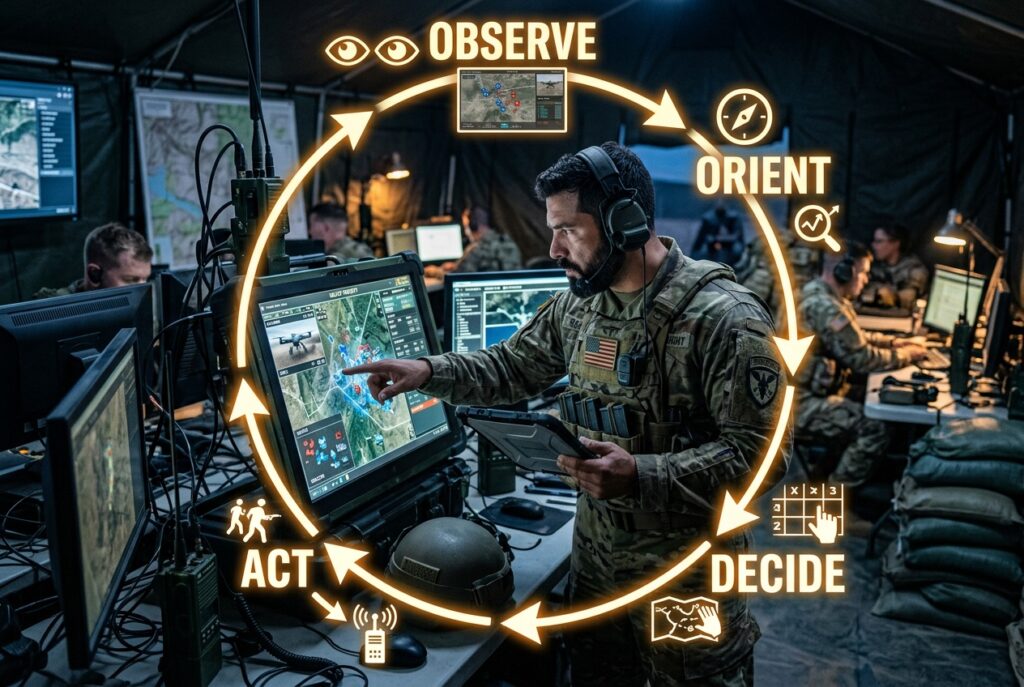
The OODA loop consists of four steps. Each step involves a different type of cognitive work, and each feeds back into the others.
Observe. This step involves gathering raw information from your environment. Sights, sounds, smells, radio traffic, body language, sensor feeds, real-time data off your phone or optics. The observation stage of the OODA loop is about soaking up everything happening right now without filtering too early.
Orient. Orient is the most important part of the OODA loop, and also the most misunderstood. Orientation is where you make sense of what you observed. Your genetic heritage, prior experience, training, cultural background, and current emotional state all shape how you orient. Two operators can watch the same scene and orient completely differently. That’s why orientation is the key to success in Boyd’s OODA framework.
Decide. Based on the orientation, you decide on the best course of action. This is a hypothesis, not a certainty. You’re picking the move that looks most likely to work given what you know right now.
Act. You execute. Then the result of your action feeds back into fresh observations, and the loop starts again. Continuous feedback is baked into the design.
The OODA Loop Diagram: What Most People Miss
The simple OODA loop diagram you see online shows four boxes in a circle. Observe, Orient, Decide, Act, with an arrow looping back around. It looks clean. It’s also wrong, or at least incomplete.
Boyd’s actual OODA loop diagram is a tangled mess of feedback loops. Orientation feeds back into observation. Acting creates new data to observe. Decisions inform how you orient next time. There are implicit guidance arrows that let you skip steps once patterns are recognized. A seasoned operator doesn’t always deliberate through every decision. Training lets you compress or even bypass stages when the situation is familiar enough.
This matters because the four-step cartoon version makes the OODA loop look like a checklist. It’s not. It’s a living system. The real OODA loop is iterative, dynamic, and messy. That’s what makes it work in dynamic environments where a rigid plan falls apart on contact.
How Long Does the OODA Loop Take?
There’s no fixed answer. A trained fighter pilot in air combat can cycle through the OODA loop in well under a second. A police officer clearing a room runs the loop continuously, maybe dozens of times per minute. A CEO making a strategic call might take months to complete one cycle. The loop’s clock runs at whatever speed the situation demands.
Reaction time is part of the equation, but it’s not the whole thing. A faster reaction with bad orientation still gets you killed. The goal is not to rush. The goal is to shrink the time between good observation and committed action while keeping the quality high. Boyd’s insight was that if you can operate inside your adversary’s decision cycle, meaning you complete your loop before they complete theirs, the adversary starts reacting to stale information. They get confused. They make mistakes. You win.
Is the OODA Loop Still Relevant?
Yes. The OODA loop may have started with an Air Force colonel and military strategist John Boyd in the Cold War era, but it’s arguably more relevant now than ever. Cyber defense teams use the OODA loop approach to respond to intrusions in real time. Agile software teams borrowed the feedback loop structure directly. Emergency room doctors, wildland firefighters, and commodity traders all run some version of this decision-making process daily.
The OODA framework scales because it describes how humans actually make effective decisions under uncertainty. Beyond military use, you’ll find Boyd’s ideas in command and control doctrine, law enforcement training, competitive sports coaching, and even parenting a toddler in a grocery store. Anywhere people face fast-changing situations with incomplete information, the OODA loop explained in Boyd’s terms still holds up. The specifics evolve, the structure doesn’t.
How to Practice the OODA Loop?
You practice the OODA loop the same way you practice shooting or jiu-jitsu. Reps under realistic pressure. Here are drills that actually build the skill.
Run “what’s wrong with this picture” reps when you walk into any space. Coffee shop, parking lot, hotel lobby. Scan, orient to exits and anomalies, decide what you’d do if things went sideways, then mentally act. Five seconds total. Do it ten times a day and you’re using the OODA loop hundreds of times a week without burning range ammo.
Practice decision games. Tactical Decision Games, developed by the Marine Corps, give you a scenario and sixty seconds to make a call. They force you to use the OODA loop under time pressure with incomplete information. Force-on-force training, whether with Simunitions, paintball, or grappling, builds the loop at speed because the other person is actively trying to break your cycle.
Debrief honestly. After any high-stakes event, walk backward through the loop. Where did my orientation fail? Did I have the information I needed? Was my decision solid but execution sloppy? Making decisions well is a skill, and skills need feedback. Over time, you develop pattern recognition that lets you skip consciously deliberating on familiar problems. That’s when the loop gets fast.
OODA Loop vs SWOT Acronym and Other Frameworks
People sometimes lump the OODA loop in with other business tools. The SWOT acronym, which stands for Strengths, Weaknesses, Opportunities, Threats, is a static analysis tool. You sit in a conference room, fill out a quadrant, and walk away with a plan. SWOT is useful for quarterly planning. It’s useless when someone kicks in your front door.
The OODA loop is different. It’s a decision-making model built for motion. Where SWOT gives you a snapshot, the OODA loop gives you a movie. Where SWOT assumes time to think, the OODA loop assumes the clock is already running. Boyd designed his framework for situations where waiting is losing. If you’re choosing between them, the question isn’t which one is better. It’s which one matches your problem.
Other cousins include the PDCA cycle (Plan, Do, Check, Act) and various agile sprint methodologies. All of them share the OODA loop’s DNA: observe reality, adjust, try something, check results, repeat.
The OODA Loop Beyond Military Use
Walk into any modern law enforcement academy and you’ll hear instructors reference the Boyd cycle. Use of force decisions, tactical entries, vehicle pursuits, all taught through some variation of the OODA loop framework. The Marine Corps embedded the loop into its maneuver warfare doctrine decades ago. United States Special Operations Command trains operators to get inside an adversary’s decision cycle as a core competency.
Outside uniforms, the OODA loop shows up in startup strategy, trading floors, and emergency medicine. Surgeons running a code, pit crews at a NASCAR race, and air traffic controllers handling a weather diversion all apply the same pattern. Observations and orientation feed into decisions, decisions become action, action creates new observations. Boyd’s ideas escaped the military and made themselves at home wherever real-time data and high stakes collide.
Evolving the OODA Loop: What Comes Next
Evolving the OODA loop is an ongoing conversation. Researchers at the Air University at Maxwell AFB and think tanks across the United States keep refining how the loop applies to drone warfare, AI-assisted targeting, and information operations. When your adversary is an algorithm, orientation takes on new meaning. When your sensors feed you terabytes per minute, observation becomes a filtering problem as much as a gathering one.
Some thinkers argue the loop needs a fifth step for modern conflict. Others say Boyd already accounted for it in his later briefings. What’s clear is that Boyd’s OODA remains the reference point. Every new decision-making framework either builds on the loop or defines itself against it. That’s the mark of a foundational idea. Nobody serious in strategy circles ignores John Boyd’s OODA loop.
For the tactical operator reading this, the practical takeaway hasn’t changed much. Keep your senses open. Build honest orientation through training and reflection. Decide with conviction. Act and learn. Then improve our capacity to do it faster next time. No adversary is certain to win against someone who owns their loop.
Key Takeaways to Remember
- The OODA loop is a decision-making framework developed by Air Force colonel and military strategist John Boyd, a Korean War fighter pilot who reshaped United States military thinking.
- OODA stands for Observe, Orient, Decide, Act. Four stages, continuous feedback, iterative by design.
- Orient is the most important stage of the OODA loop because your genetic heritage, prior experience, and training shape every decision that follows.
- The real OODA loop diagram is full of feedback loops, not a simple four-box circle.
- Speed through the loop matters, but quality of orientation matters more. Reaction time without good orientation gets you in trouble.
- The OODA loop applies in air combat, law enforcement, business, sports, and any competitive environment with incomplete information.
- Practice the loop with observation drills, Tactical Decision Games, force-on-force training, and honest debriefs.
- The OODA framework differs from the SWOT acronym because SWOT is static analysis while OODA is built for motion and dynamic environments.
- Beyond military applications, the Marine Corps, police, medical teams, and agile software developers all use variations of Boyd’s OODA loop.
- Getting inside an adversary’s decision cycle, so they’re always reacting to stale information, is the key to winning under pressure.